timer 40% Price Increase Coming Soon, Lock In Your Rate Today arrow_forward
Blog Login Start Free Trial

Forex Margin Calculator

Set the instrument, lot size, and leverage to see the exact margin a position needs, its margin level, and how far price can move before a margin call.

Margin
lots
Margin call
USD
%
%
$1,085.00
toll required margin
margin to open this position
Notional value $108,500
Margin as % of notional 1.00%
Free margin $3,915.00
Margin level 460.8%
Price move to margin call 0.03915 (391.5 pips)
indicative price Runs in your browser

Educational tool, not financial advice. Results depend on your broker's contract specs and pricing. Runs in your browser. Nothing you enter is stored. Leverage limits vary by regulator and broker. Confirm your account's limits before trading.

Embed This Calculator

Add the Margin Calculator to your website or blog. Copy the code below and paste it wherever you want the calculator to appear, it auto-adjusts to fit any container. Please keep the attribution line intact.

help_outline How to use this calculator

  1. 1Pick your instrument and account currency.
  2. 2Enter the position size in lots.
  3. 3Choose your leverage, for example 1:30, 1:100, or 1:500.
  4. 4Read the required margin, notional value, and margin percentage.
  5. 5Open the margin-call panel and add a balance to see margin level and the move to a call.

The Margin Formula (with a Worked Example)


                Notional value = lot size x contract size x price
Required margin = notional value / leverage
Margin level % = equity / used margin x 100
              

Worked example: one standard lot of EURUSD (100,000 units) at 1.0850 is 108,500 of notional. At 1:100 leverage the margin is 108,500 / 100 = 1,085.00. At 1:500 the same position needs only 217.00, but its size, and the loss a stop would take, are unchanged.

Margin for 1 Lot of EUR/USD Across Leverage

LeverageMargin requiredNotional controlled
1:30 (ESMA retail cap)$3,616.67$108,500
1:100$1,085.00$108,500
1:200$542.50$108,500
1:500$217.00$108,500

Margin, Free Margin, and Margin Level

Used margin is the part of your equity locked up to hold open positions. Free margin is what is left, the equity you can still use to open new trades or absorb losses on the ones you have. As open trades move into profit or loss, your equity changes, and with it your free margin.

Margin level ties the two together: it is equity divided by used margin, shown as a percentage. A margin level of 500% means your equity is five times the margin in use, which is healthy. As losses eat into equity the margin level falls, and when it hits your broker margin-call threshold the broker starts protecting itself.

Leverage Caps by Regulator

How much leverage you can use depends on where your broker is regulated. Under ESMA rules in the European Union, retail forex leverage is capped at 1:30 on major pairs and lower on more volatile instruments. In the United States the NFA caps major-pair leverage at 1:50. Offshore brokers often advertise 1:500 or more, which lowers the margin per trade but does nothing to lower the risk.

The calculator lets you model any of these so you can see the trade-off directly. Higher leverage frees up margin, letting you hold more positions at once, but each position is exactly as risky as before. Regulators cap leverage precisely because cheap margin tempts traders into sizes their accounts cannot survive.

Margin Call and Stop-Out: the Mechanics

A margin call is a warning that your margin level has fallen to the broker threshold, often 100%, meaning your equity has dropped to roughly the margin in use. If losses continue and the level reaches the stop-out threshold, often 50%, the broker begins closing your positions automatically, starting with the largest loser, to stop the account going negative.

The "price move to margin call" row estimates how far the market can move against your open position before that first call, using the pip value of the position. It is a linear approximation: on some account types the true trigger shifts slightly as price moves, so treat the number as a planning guide, not a precise line in the sand.
quiz Frequently Asked Questions

What is the margin for 1 lot at 1:100?expand_more
It depends on the notional value of the lot. For one standard lot of EURUSD at 1.0850, the notional is 108,500, so at 1:100 leverage the margin is 108,500 / 100 = 1,085. For gold or an index the number differs because the contract size and price differ.
What is the difference between margin and free margin?expand_more
Margin (used margin) is the equity locked up to hold your open positions. Free margin is the equity that is left over, which you can use to open new trades or to absorb losses on existing ones. Free margin equals your equity minus your used margin.
What margin level triggers a margin call?expand_more
It is set by your broker, but a call commonly fires when margin level (equity divided by used margin) falls to 100%, and a stop-out, where positions are force-closed, often at 50%. Check your broker terms, as these thresholds vary.
Does required margin depend on my stop loss?expand_more
No. Margin depends on position size, price, and leverage, not on where you place your stop. Your stop loss determines your risk, how much you lose if it is hit, which is a separate number. That is why you size a trade by risk and check margin separately.
Why is the margin on gold so high?expand_more
Because a standard lot of gold (XAUUSD) controls 100 ounces, and at a gold price of several thousand dollars the notional value is large, often over 300,000 per lot. Even a small margin percentage of a large notional is a big number, which is why gold ties up more margin than most forex pairs.
Is higher leverage more margin efficient but riskier?expand_more
Higher leverage is more margin efficient: the same position ties up less of your equity, so you can hold more trades at once. It is not directly riskier by itself, but the cheap margin makes it easy to open sizes your account cannot survive, which is the real danger. Size by risk, then check the margin.

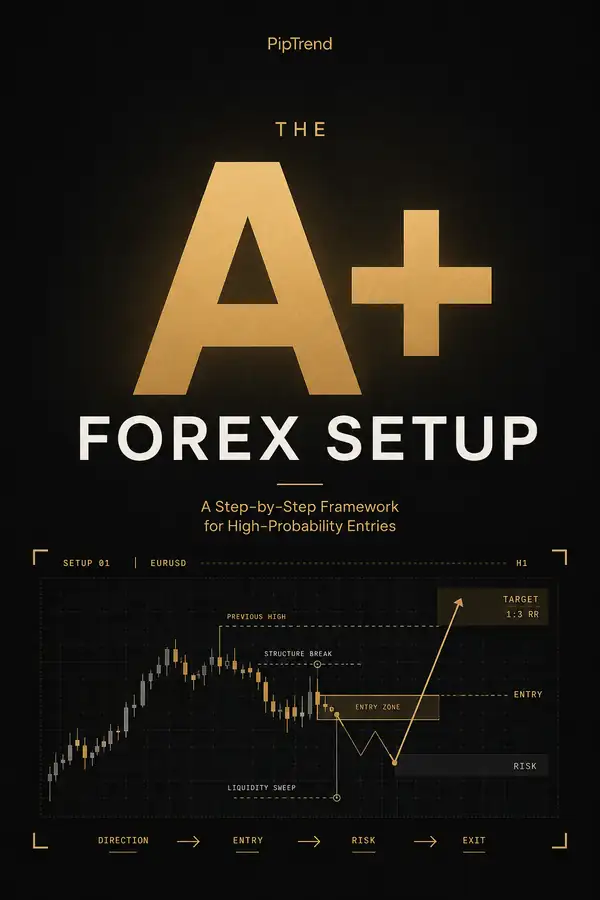
Get the free PipTrend A+ setup guide

We're finishing it now: the exact entries, exits, and risk rules our traders use, on one chart. Leave your email and we'll send it the day it's ready.

grid_view

Explore All Free Tools

Browse our full library of calculators, market tools, and trading resources.

Browse all tools arrow_forward

Want Smarter Signals on Your Chart?

These tools help you plan. PipTrend helps you execute, with a smart signal engine and adaptive trend detection right on your TradingView chart.

Secure checkout via Whop · Instant access · 30-day money-back guarantee